There is a short burning sensation as the acid is applied to each scar, lasting seconds. No anaesthetic is needed.
Overview
One scar at a time, from the base upward
CROSS stands for Chemical Reconstruction Of Skin Scars. Acid is applied to the base of one scar at a time — never to the whole face.
Ice-pick scars are the ones that defeat most treatment plans. They are often less than two millimetres across but run deep and steep, and no fractional device delivers meaningful energy to the bottom of a channel that narrow. Resurfacing the surrounding skin only makes the surrounding skin better.
TCA CROSS solves the geometry problem directly. A small, precise volume of trichloroacetic acid is placed at the base of each individual scar. It produces a controlled chemical injury exactly where the correction is needed, and the fibroblast response that follows lays down connective tissue that pushes the floor of the scar upward.
It is a technique that rewards precision over power. Each session takes only a few minutes, and treatments are repeated at four- to six-week intervals — longer still where the concentration is high or the skin is darker. Most courses run to three or four sessions. The published series report good to excellent improvement in the large majority of treated scars, and we quote it that way deliberately: there is no validated grading scale for acne scarring, so the precise percentages that circulate in clinic copy are not comparable between studies and should not be read as promises.
At a glance
- Treatment timeA few minutes
- AnaestheticNone required
- DowntimeSwelling for a day, pinpoint crusts for 3–7 days
- SessionsUp to 4 for an optimal result, 4–6 weeks apart
- ResultsGood to excellent improvement in most treated scars across published series
- Combines withSubcision, CO2 laser, Genius RF
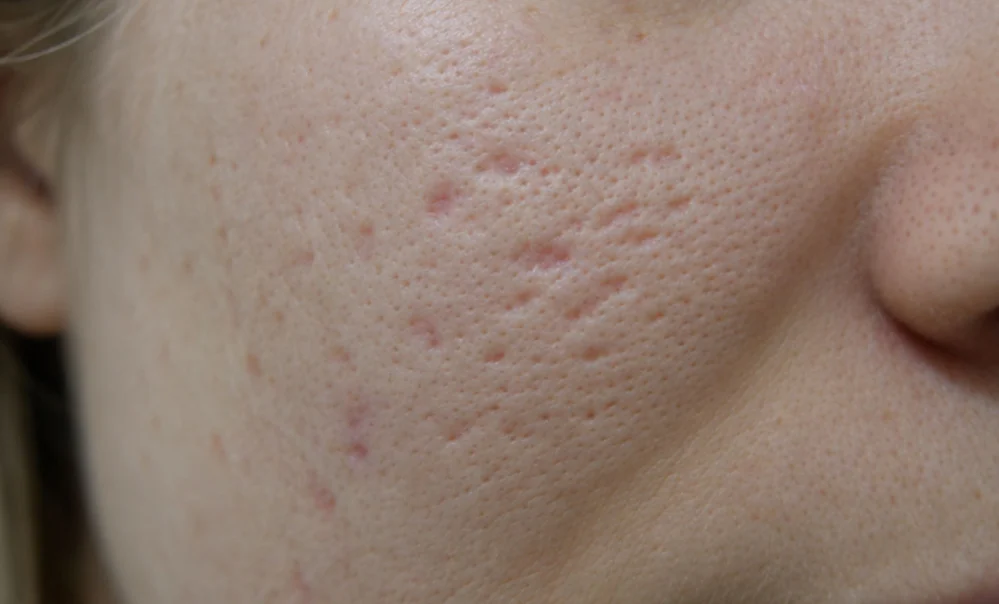
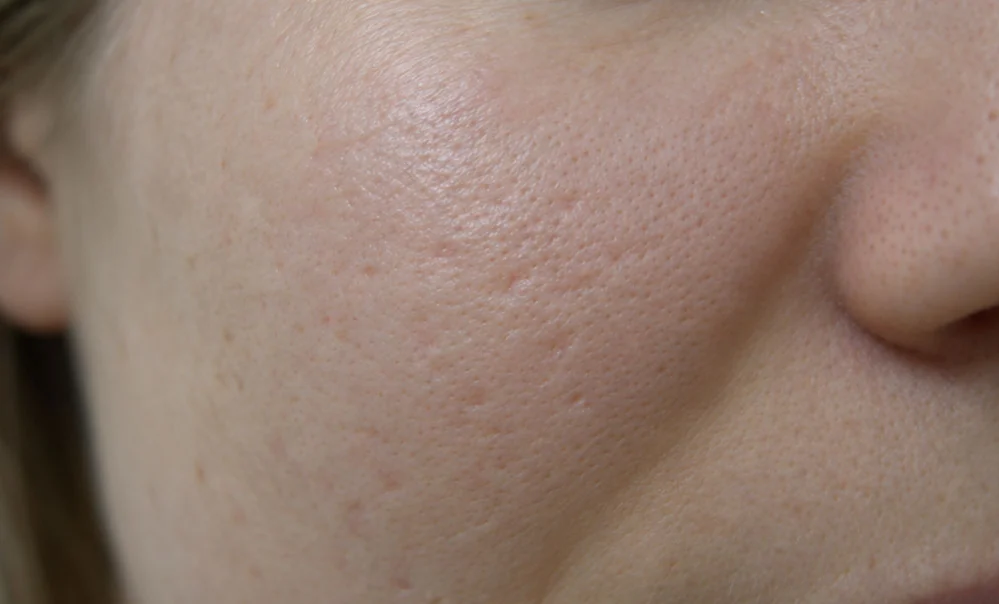
The two photographs were taken at different visits, so the frames are cropped and one is rotated to line them up. Nothing in the skin itself has been altered — no retouching, no filtering, no change of scale. Every result is an individual outcome and results vary between patients.
How it works
Controlled injury, exactly where it is needed
Each scar is identified and marked. A minute quantity of TCA solution is then applied to the base of that scar alone, using a fine applicator. Within moments the treated point turns white — the characteristic “frosting” — and that frost resolves within a few hours.
Beneath it, the acid has triggered a wound-healing cascade confined to the scar. Fibroblasts migrate in and produce collagen, and over the following weeks the base of the scar is rebuilt from underneath and the opening narrows. The surrounding skin, never touched by the acid, is unaffected.
Concentration is a genuine clinical decision rather than a badge. Published series use anything from 50 to 100 per cent, and there is no robust head-to-head evidence establishing an optimum — what is established is that the higher concentrations demand longer intervals and carry more pigmentary and scar-widening risk. In darker skin we may prime for a fortnight beforehand with a pigment-inhibiting agent in the morning and a retinoid at night, and continue it afterwards. In the best-documented series in Fitzpatrick IV and V skin, that protocol produced excellent improvement in nearly three-quarters of patients with only three transient pigmentary events in thirty.
Indications
Suited to
- Ice-pick scars — narrow, deep and steep-walled
- Narrow boxcar scars
- Enlarged pores and dilated follicular openings
- Linear scars
- Individual scars scattered through otherwise good skin
- As a component of a combined session with subcision or an energy device
- Rolling, tethered scars — subcision is the instrument for those, and does it better
- Wide, shallow boxcar scars, where resurfacing is more efficient
- Active infection or a cold sore anywhere in the field
- A keloid tendency
- Someone who has been told to expect a peel — this is not one, and the recovery looks nothing like one
In the clinic
Step by step
Identification
Scars suitable for CROSS are identified and marked. Not every depression benefits — wide boxcars and rolling scars are better served by other methods.
Application
A fine applicator places a very small volume of trichloroacetic acid at the base of each marked scar. You feel a brief burning sensation.
Frosting
The treated points turn white within seconds. This is expected and confirms the acid has reached the depth intended. The frost settles within about an hour.
Crusting and healing
Small crusts form over the treated points and separate over three to ten days, occasionally a little longer. Antibacterial ointment is applied daily for the first three days.
Repeat
The session is repeated after four to six weeks. Up to four sessions are typical for an optimal result.
Recovery
Recovery and risks
Small, dark crusts over each treated scar are the visible sign of a treatment that is working.
Expect swelling for around a day, pinpoint crusts for three to seven days, and gradual redness afterwards that can persist for four to six weeks. Minor infection is uncommon and manageable. Rarely, a treated scar can temporarily appear slightly larger before it improves. In darker skin types, transient pigmentation changes may occur and typically resolve during healing.
Sun protection matters here. Daily SPF 30 or higher for the month after treatment substantially reduces the risk of post-inflammatory pigmentation.
The first minutes
A short burning sensation as each scar is treated, then white frosting at every treated point. The frost fades within the hour, leaving redness and local swelling.
Four to six hours
Redness and swelling are already settling.
Day one
A small dark crust usually form over each treated scar. Patients expect something that looks like a peel and instead get a scatter of tiny dark dots — which is exactly right, and worth knowing in advance.
Days three to seven
The crusts shed, in most patients by day four. Occasionally one holds on for a week.
Weeks two to twelve
Pinkness fades gradually. The base of the scar continues to rebuild, and the result is judged at three months rather than at three weeks.
Risks
What can go wrong
Expected
Burning for seconds, frosting, a day of swelling, pinpoint crusts for three to seven days and residual pinkness for several weeks.
Uncommon
Post-inflammatory hyperpigmentation — the commonest adverse event by a distance, with reported rates across the literature ranging from under seven per cent to over sixty depending on phototype, priming and interval. It is usually transient. Transient lightening is less common.
Rare but serious
Widening of a treated scar, or deeper atrophy than there was before. This is the complication that matters, it is documented in several published series, and it is attributed to poorly controlled application — too much acid, or acid that ran outside the scar. If widening or tethering occurs, microsubcision may help improve the widened scar.
That last point is the argument for who holds the applicator rather than which acid is in the bottle. A technique whose principal risk is making the scar bigger is not one to learn on your own face.
Evidence
What the evidence shows
Consistent for ice-pick, technique unresolvedAcross a review of thirty-four publications, this technique performs well for the scar type nothing else reaches. Compared head to head: it outperformed microneedling for ice-pick scars while microneedling did better for rolling ones; fractional CO2 achieved greater overall severity reduction; subcision was better for rolling scars with less pigmentary disturbance.
Read together, those comparisons make the same point from five directions: scar subtype, not device preference, decides what should be used. That is the single best-supported principle in the whole of acne scar revision, and it is why this practice treats most faces with more than one method in the same session.
What is not settled is the optimal concentration or interval. Anyone who tells you 100 per cent is definitively better is ahead of the evidence.
If you are travelling
You can fly the same day. What you cannot do is arrive somewhere that evening looking untreated — the crusts appear within a day and are visible for the best part of a week.
A course is three or four sessions at four- to six-week intervals, which for most international patients means combining it into sessions arranged around other scar work rather than travelling for it alone.
Sun avoidance for the month afterwards is the condition on which the pigmentary risk depends, and it is the reason we will sometimes suggest treating in winter.
Questions
Good to know
If your question is not here, ask it in the enquiry form — Dr. Henningsen and his team answers these personally.
Ask a question- Does it hurt?
- Why not treat the whole face with acid?
Because the problem is not the whole face. A full-face peel treats the surface of healthy skin and leaves the base of a deep scar untouched. CROSS puts the injury exactly and only where the reconstruction is required.
- How many scars can be treated in one session?
Dozens, if that is what your skin needs. The limiting factor is the crusting you are willing to live with over the following week, not the technique.
- Can it be combined with laser on the same day?
Yes, and it frequently is. A typical combined session releases tethered scars by subcision, treats ice-pick scars with CROSS, and then resurfaces the field with CO2 or radiofrequency microneedling (Genius).
Consultation
Ready to talk about your skin?
Consultations with Dr. Henningsen are arranged individually. Tell us what you would like to change and we will come back to you with the options, the honest downtime and the realistic result.