The injection of local anaesthetic is the uncomfortable part, and it takes seconds. During the release itself you feel movement and pressure but not pain.
Overview
Cut the tether, and the scar can rise
If a scar is being pulled down from underneath, nothing applied to the surface will lift it. Subcision cuts the tether.
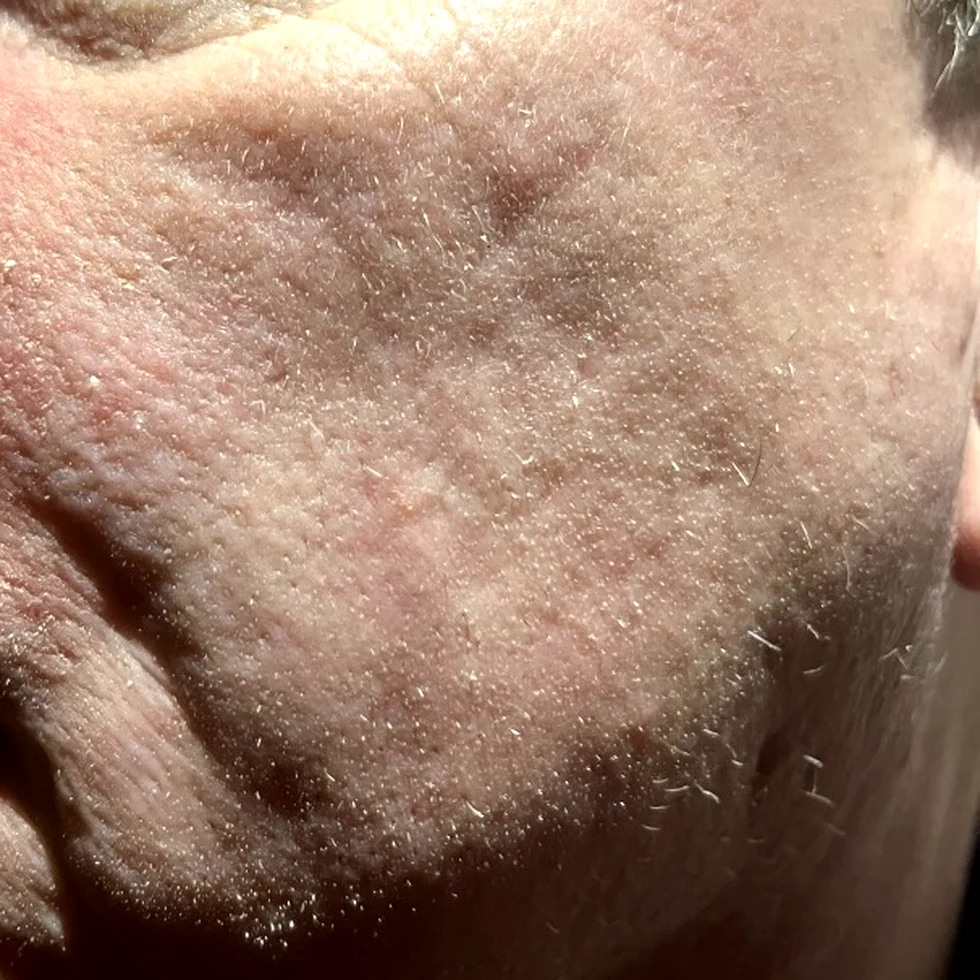
Rolling scars are not simply missing tissue. They are dips held in place by strands of fibrous scar tissue that run from the underside of the scar down into the dermis and beyond. As long as those bands are intact, the floor of the scar cannot rise — which is why patients who have had several courses of laser resurfacing often report that their skin looks smoother but the dips are still there.
Subcision can be performed at different tissue levels depending on the type and depth of the scar. Microsubcision is performed intradermally using a very fine needle, targeting individual tethering points directly beneath each scar. It is usually performed without local anaesthetic and may be combined with a small amount of hyaluronic acid filler. The filler helps support the released scar and may reduce the risk of re-tethering during healing. Field subcision is used for deeper, more firmly tethered scars and is performed under local anaesthetic. A cannula or other dissection technique is passed beneath the scar to release deeper fibrous attachments. This may be combined with injection of a collagen-stimulating filler, such as diluted Radiesse or Sculptra. This helps maintain separation between the released tissue planes, reduce re-tethering and restore volume loss beneath deeper scars.In both approaches, releasing the fibrous attachments allows the scar base to rise, while the subsequent healing response promotes collagen remodelling within the treated tissue.
That is the fundamental difference between subcision and simply filling a depressed scar. A filler adds volume beneath the scar, whereas subcision addresses the fibrous tethering that is pulling the scar down.In practice, a single treatment does not always achieve complete or permanent release. Fibrous attachments may be only partly divided, and some degree of re-tethering can occur during healing. This is one reason why deeper or more complex scars may require more than one subcision procedure.Published studies also suggest that some of the early improvement after subcision can diminish over time. The long-term durability of release, and whether one instrument or technique provides more reliable results than another, remains incompletely defined in the literature. For this reason, technique, treatment depth and measures to reduce re-tethering are important parts of the procedure.
At a glance
- Treatment time10–60 minutes depending on the field
- AnaestheticNone, local infiltration or tumescent anaesthesia
- DowntimeSwelling for 2–4 days. Bruising may occur and usually resolves within 7-10 days.
- SessionsTypically 1–4 sessions, depending on scar depth, tethering and response. Subcision is often repeated as part of a broader scar-revision plan.
- ResultsThe degree of lasting scar elevation varies between patients. Some re-tethering can occur during healing.
- Combines withCO2 laser, Genius RF, TCA CROSS, fillers
How it works
Three techniques, chosen by what needs releasing
Taylor Liberator subcision (TLS) is used where scarring is widespread and severely tethered — diffuse rolling scars held by many fibrous bands across a large field. It dissects tissue with a sharp instrument and is generally more effective than blunt techniques, at the cost of more swelling, bruising and a longer recovery.
Intradermal or micro-subcision works in the superficial layers with a fine needle, usually 25G. It is precise for individual scars but less suited to large areas, and pairs well with a hyaluronic acid filler or a biostimulator such as Radiesse.
Cannula subcision uses a blunt cannula in the subcutaneous plane. Less aggressive, safer in certain facial areas, less bruising and a shorter recovery — but it covers a smaller field and may need to be repeated.
Which one you need is a judgement made on your skin, not a house protocol. Most treatment plans use more than one across a course.
Indications
Suited to
- Rolling acne scars tethered to deeper tissue
- Depressed scars after trauma or surgery
- Scars that have plateaued despite repeated laser treatment
- Tethered scarring on the cheeks, temples and jawline
- Skin of all types — subcision carries no pigment risk from light energy
- Ice-pick scars — there is no tether to release, and TCA CROSS is the right instrument
- Sharply walled boxcar scars, which respond better to resurfacing
- Acne that is still active in the field to be treated
- Anticoagulant or antiplatelet treatment that cannot safely be paused — bruising is the whole mechanism here
- A history of keloid scarring
- An expectation that one session will finish the job
In the clinic
Step by step
Marking and photography
Scars are marked with the patient sitting upright in the light where they are most visible, then photographed against a standardised background.
Anaesthesia
Local anaesthetic is infiltrated, or tumescent anaesthesia is used where a wide field is being released.
Release
A bladed needle or cannula is passed beneath each scar and moved in a fanning motion to divide the fibrous bands. You feel pressure rather than pain.
Immediate response
Bruising and swelling begin at once and are expected — this is the released space filling with blood, which becomes the scaffold for new collagen.
Aftercare
Gentle daily cleansing with a mild soap and apply a mild moistorizer. Make-up can usually cover any discolouration after one day.
Recovery
Recovery
Bruising and swelling appear immediately and settle over the following weeks. The bruise is not a side effect of subcision; it is the mechanism.
Aftercare. Gentle cleansing, an antibacterial ointment for a week, and — once the first days have passed — firm daily massage of any palpable lump. Massage is the single thing that most shortens the nodule phase.
The same day
Swelling begins on the table. Released scars often look better for an hour or two, then disappear under the swelling. Expect to look as though you have been struck, not as though you have had a facial.
Days one to four
Peak bruising and oedema. In published comparisons a haematoma forms in a minority — roughly one patient in twenty with a blunt cannula, and considerably more with a bladed needle. Make-up usually covers the discolouration from around day two.
Days five to ten
The bruise fades through the usual colours. Most patients are socially comfortable by the end of the second week.
Weeks two to eight
Firm nodules can be felt, and occasionally seen, where blood has organised in the released plane. These settle over one to two months and respond to daily massage; a stubborn one can be softened with a small injection.
Months one to three
The real lift arrives here, as the released plane fills with new collagen rather than with blood. The result is assessed at three months, not at three weeks.
Risks
What can go wrong
Expected
Bruising, in practice universal. Swelling, tenderness and a feeling of tightness for several days.
Uncommon
A haematoma that needs to be drawn off rather than left to resorb. Firm subcutaneous nodules. Post-inflammatory pigmentation, which relates to the entry points and to sun exposure afterwards rather than to the release itself — this is why entry points are kept few and small in size.
Rare but serious
Infection. Numbness from bruising around a sensory nerve, which is usually self-limiting but can take six to eighteen months to settle fully. Over-filling, producing a ridge rather than a smooth plane. Hypertrophic scarring at an entry point, reported from the original descriptions of the technique onwards.
Technique accounts for most of the difference in these figures. Blunt instruments, remote entry points and staged undermining consistently produce fewer complications than a bladed needle worked through many entries, which is the main reason a cannula is used wherever it will reach.
Evidence
What the evidence shows
Mechanism clear, comparisons contradictoryThat releasing a tether lets a tethered scar rise is not in dispute, and biopsy work after both needle and cannula subcision shows new collagen laid down in the released plane. What the literature does not settle is which instrument is best.
Published comparisons point in opposite directions. One study of a hundred patients found a 39 per cent improvement with a bladed needle against 85 per cent with a cannula; another, of forty-six patients over six monthly sessions, found almost the reverse — 74 per cent with the needle against 65 per cent with the cannula. What is consistent across every comparison is that the cannula causes less bruising, fewer nodules and less scarring at the entry points.
The honest synthesis is that the cannula is safer and better tolerated, that efficacy between the two is unresolved, and that the choice is therefore made on the individual scar field rather than on a claim of superiority. Combination is better evidenced than any instrument on its own: subcision with an energy based device, with a hyaluronic acid filler or with a biostimulator outperformed subcision alone in every study that tested it.
If you are travelling
Subcision alone is compatible with flying the same day or the next. What makes travel awkward is not the procedure but the bruise, which is at its worst on days two to four — so if there is a face you need to show on this trip, plan the procedure at the end of it rather than the beginning.
Subcision may be combined with an energy based device which can increase the overall downtime.
The key review is at around three months, using standardized photographs compared with baseline images. Ideally, this is performed in the clinic under the same lighting, positioning and camera perspective.
Questions
Good to know
If your question is not here, ask it in the enquiry form — Dr. Henningsen answers these personally.
Ask a question- Is subcision painful?
- Why not just use filler?
Filler occupies the depression; subcision removes the reason it exists. Filler is temporary and, over a tethered scar, tends to look tented rather than smooth. The two are often used together — release first, then support the floor while collagen forms.
- How soon can I see a result?
Some lift is visible as soon as the swelling settles, but the meaningful change comes from the collagen laid down over the following three to six months.
- Will the fibrous bands grow back?
Not in the way they were. But a needle or cannula perforates the bands rather than cutting every one of them cleanly, so a scar held by heavy tethering is rarely fully released in a single pass — and one published split-face study found part of the early gain had been lost by six months. That is why a course usually includes subcision more than once, and why we photograph and reassess rather than assume.
- Is it true that subcision is permanent?
Partly. The bands that are divided do not re-form, so what is released stays released — but "permanent" overstates it, because what is released in one session is usually not all of it, and the literature on how well the correction holds is genuinely mixed. We would rather you heard that from us than discovered it at six months.
Consultation
Ready to talk about your skin?
Consultations with Dr. Henningsen are arranged individually. Tell us what you would like to change and we will come back to you with the options, the honest downtime and the realistic result.