No. Striae are scars and cannot be removed. What treatment reliably does is make them shallower, narrower and less distinct from the skin around them — often to the point where they stop being the thing you notice.
Overview
Striae are scars, and behave like them
Striae are scars in the dermis. They respond to the same remodelling logic — over a longer horizon, and with expectations set honestly from the first visit.
Stretch marks form when the dermis is stretched faster than it can adapt and the collagen and elastin framework tears. Early striae are red or purple because of the inflammatory response and the vessels beneath; mature striae are pale, slightly depressed and finely wrinkled.
The distinction matters for treatment. Red striae still have an active biology to work with and generally respond better and faster. White, mature striae are established scar tissue and need a dermal remodelling approach with a longer timeline.
Radiofrequency microneedling is the mainstay here: it delivers energy to the depth where striae actually live, over the large body areas where they typically occur, with recovery measured in days. Fractional laser has a role on selected areas and skin types.
We would rather set the expectation at the top of the page than at the bottom of the consultation. Striae are permanent dermal lesions, and the systematic reviews are unanimous that no treatment has proved completely effective. In the largest review of outcomes — 151 studies and nearly five thousand treatment outcomes — complete clearance of white, mature striae with CO2 laser was achieved in 4 per cent. What good treatment reliably does is make them shallower, narrower and closer in colour to the skin around them, so that they stop being the first thing you see. If you are being offered removal, you are being offered something nobody can deliver.
At a glance
- Treatment time20–45 minutes depending on the area
- AnaestheticTopical anaesthetic
- DowntimeRedness for 24–48 hours; mild peeling for a few days
- Sessions3–5, spaced 6–12 weeks apart
- ResultsGradual over 3–6 months; improvement rather than removal
- Combines withGenius RF, fractional laser, topical retinoid support
How it works
Rebuild the framework that tore
Energy delivered into the dermis triggers fibroblasts to produce new collagen and elastin in the damaged band. As that framework rebuilds, the striae become shallower, narrower and closer in texture and colour to the surrounding skin.
For red striae, treatment also addresses the vascular component, which shortens the time to visible change. For white striae, the work is purely structural and progresses over months.
Body skin remodels more slowly than facial skin, and treatment intervals are spaced accordingly — typically six to twelve weeks.
Indications
Suited to
- Striae on the abdomen after pregnancy or weight change
- Striae on the thighs, hips and buttocks
- Striae on the arms, breasts and shoulders
- Early red or purple striae — the most responsive stage
- Mature white striae, with a longer timeline
- Skin laxity accompanying striae
- Anyone expecting removal rather than improvement
- Striae that are still actively forming, during pregnancy or a period of rapid growth or weight change
- Active infection or inflammation in the area
- A tendency to keloid scarring
- Skin that is tanned, or will be tanned, during the course
- Isotretinoin within the preceding months, where ablative treatment is planned
In the clinic
Step by step
Assessment
Colour, width, depth and distribution are assessed and photographed. Red and white striae are treated with different settings.
Topical anaesthetic
Applied across the treatment area and left to work.
Treatment
Radiofrequency microneedling at a depth matched to the striae, layered across the field.
Recovery
Redness for a day or two and light peeling. Normal activity the same day; avoid heat and heavy exercise for 48 hours.
Repeat at six to twelve weeks
Three to five sessions is a typical course, with results assessed over three to six months.
Documented results
Before & after
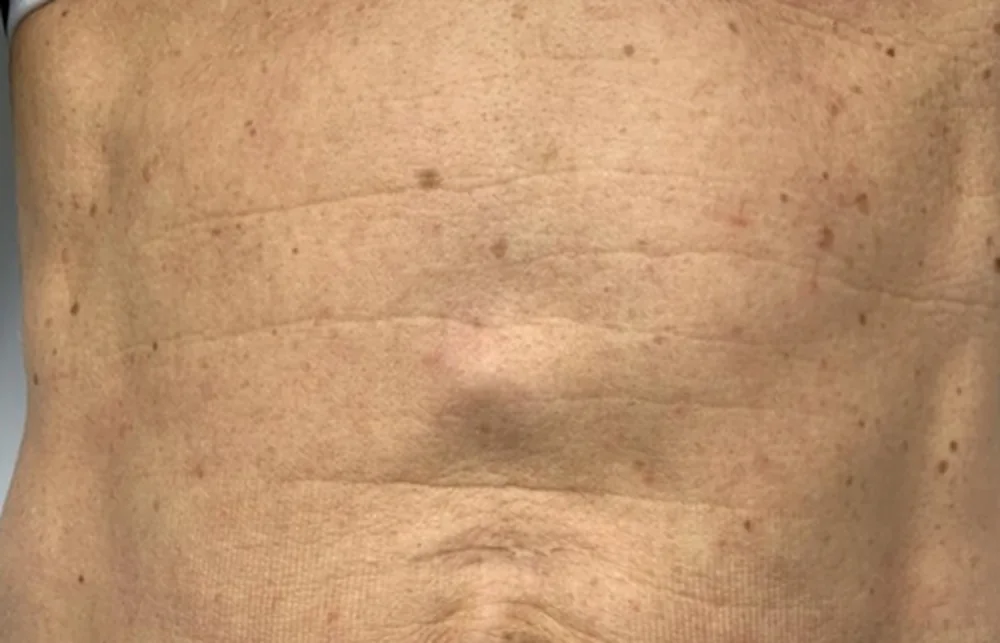
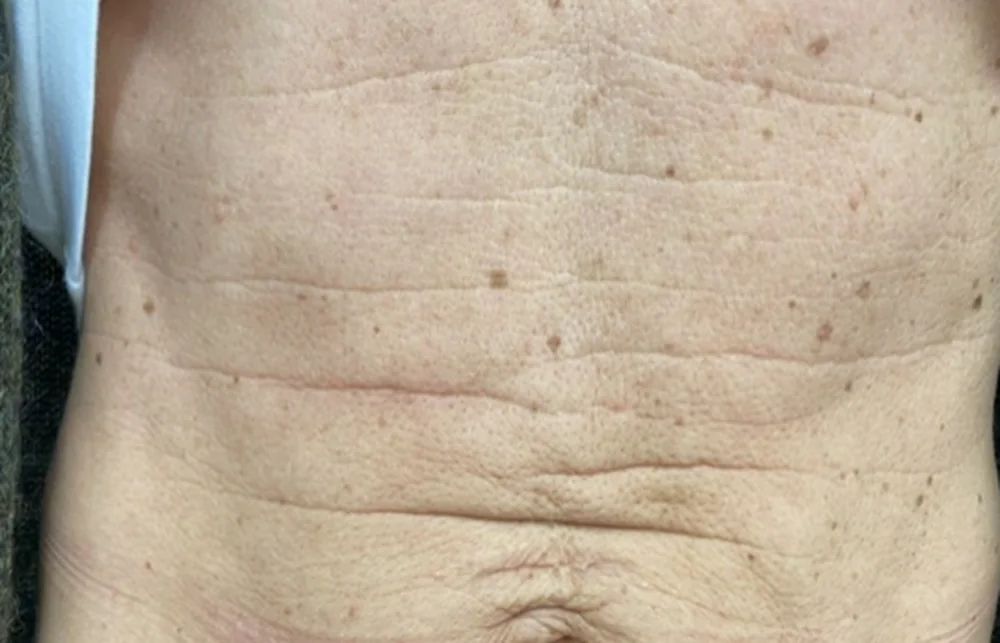
Drag the handle across each photograph to reveal the result. All images are unretouched and published with written patient consent.
Recovery
Downtime, honestly
Days nought to two
Redness and swelling over the treated band. Microneedling-based treatment is, in several comparative studies, more uncomfortable during the session than laser — the recovery is the easier half.
Days two to four
Redness settling, fine flaking. Loose clothing over the area; no swimming pools.
Days five to seven
With a fractional ablative laser rather than radiofrequency, allow up to a week, and more care with pigment afterwards.
Weeks four to twelve
Sessions are repeated at six- to twelve-week intervals, three to five in a course. Body skin remodels more slowly than facial skin and nothing should be judged before three months.
Months three to six
The result. Improvement appears to be retained over the follow-up that has been published, which is around ten months at longest. Whether it holds beyond that has not been studied, and it is partial in any case.
Risks
What can go wrong
Expected
Redness, swelling and discomfort during and after treatment; fine flaking for a few days.
Uncommon
Post-inflammatory hyperpigmentation, which is the dominant risk and is markedly more likely with ablative fractional laser than with needling-based treatment in darker skin.
Rare but serious
Worsening of the pale appearance of white striae — these lesions are already hypopigmented, and further pigment loss is a real adverse outcome rather than a theoretical one. Infection. Scarring.
Evidence
What the evidence shows
Weak across the boardThe defining systematic review of this field states that striae are permanent dermal lesions and that no treatment has proved completely effective, citing low-quality evidence, small samples and inconsistent outcome measures. The largest outcomes review puts complete response for CO2 laser in white striae at 4 per cent across 341 treatment outcomes.
Within that, the comparisons are consistent. A meta-analysis of eleven studies found microneedling statistically indistinguishable from laser for clinical improvement — while causing significantly less post-inflammatory pigmentation. Radiofrequency microneedling and fractional CO2 show no clear superiority over one another. Combinations outperform single modalities.
So the sensible reading is: choose by safety rather than by claimed power, treat red striae early while there is still an active biology to work with, and plan for partial improvement over three to six months. Anyone who presents one device as decisively better than the others is ahead of the evidence.
If you are travelling
No travel restriction beyond comfort — loose clothing, and no pool or sea for several days.
The course is the planning problem: three to five sessions six to twelve weeks apart. For most international patients this is better arranged near home with a plan agreed here, unless it is being combined with other work.
Sun is the governing constraint. Treated body skin that is then exposed on a Spanish beach is how post-inflammatory pigmentation happens, so this is not a treatment to begin at the start of a summer holiday.
Questions
Good to know
If your question is not here, ask it in the enquiry form — Dr. Henningsen answers these personally.
Ask a question- Will my stretch marks disappear?
- Is it better to treat them early?
Yes. Red and purple striae have an active biology to work with and respond faster than mature white ones.
- Can I be treated while breastfeeding?
Radiofrequency microneedling of the abdomen is generally not performed during pregnancy. Breastfeeding is usually not a barrier, but this is a conversation for the consultation.
- How long until I see something?
Texture change begins within weeks; the meaningful improvement builds over three to six months as collagen matures.
Consultation
Ready to talk about your skin?
Consultations with Dr. Henningsen are arranged individually. Tell us what you would like to change and we will come back to you with the options, the honest downtime and the realistic result.